


 02 9541 3500
MICROMERITICS ACCUPYC ADVANCED GAS PYCNOMETER
The Accupyc delivers the highest available accuracy and repeatability in a system that is fast and easy for any operator to use. Perform a measurement, review past results, send a report to print or to LIMS with the touch of a finger.
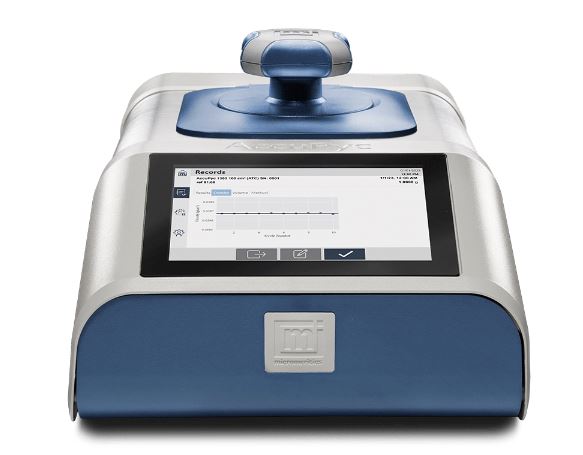
MICROMERITICS ACCUPYC ADVANCED GAS PYCNOMETER
The Accupyc delivers the highest available accuracy and repeatability in a system that is fast and easy for any operator to use. Perform a measurement, review past results, send a report to print or to LIMS with the touch of a finger.
| Manufacturer | Micromeritics |
|---|---|
| Product Series | Micromeritics Accupyc |
| Measurement principle | Gas Displacement Pycnometry |
| Application | Density, pore size and volume |
| Temperature | 4 °C to 60 °C (±0.025 °C) |
| Cell volume (Nominal) | 0.1 to 100 cm3 |
Product Overview
The AccuPyc gas pycnometer from Micromeritics is trusted around the world to provide the most reliable determinations of True or Skeletal (Absolute) Density
of solid materials and slurries. With the highest available accuracy and repeatability, the Accupyc system is now faster and even easier for any operator to use.
With advanced temperature control (to ±0.025 °C or better), AccuPyc enables the most repeatable, reliable density measurement every time. The system equilibrates faster and exchanges gas more efficiently leading to shorter run times. Solid density can be measured with Nitrogen, Air, Argon and more with no additional steps, calibrations or compromise. An analysis temperature range of 4°C to 60°C – the widest available – empowers users to measure density at their process temperature, whether replicating refrigerated biopharmaceutical storage or elevated-temperature manufacturing.
A new hinged, self-aligning lid provides frustration-free operation and constant chamber volume, ensuring reproducibility. The new Breeze touchscreen interface provides intuitive instrument control and results review for users with any level of experience. The integrated MIC Net centralises density data across the lab, including forward compatibility with existing AccuPyc systems. A wide analysis volume range from 100 cm3 to 0.1 cm3 permits large volumes that eliminate sampling error in heterogenous materials through low volumes that conserve scarce materials. These features, plus new capabilities like PowderSafe mode and the stored Method Library make the AccuPyc the easiest pycnometer in the world to operate.
Whether testing light powders, granules, foams, or slurries, operating conditions can be defined, stored in the Method Library and recalled the next time it’s needed. The FoamPyc methods follow ASTM and ISO methodologies to determine open and closed cell content, compressibility and cell fracture with chemically and mechanically formed cellular polymers such as PVC, polystyrene and polyurethane.
The Accupyc will benefit scientists who develop and optimise materials in fields like battery anodes and cathodes, additive manufacturing, catalysis, ceramics, pharmaceuticals, and more.
HOW GAS PYCNOMETRY WORKS
Using gas pycnometry, a sample is placed in a chamber of known volume, which is sealed and pressurised. The gas fills the empty spaces within and between the sample particles. The sample chamber is then expanded to an adjoining reference chamber of known volume. The change in pressure is used to calculate the volume of the sample. True density is calculated from the sample mass and the volume it occupies. This method is useful for determining the true density of materials, even those with small pores and irregular shapes.
- Demonstration video
- Benefits
- Applications
Demonstration video
Benefits
Hinged Self-Aligning Lid provides frustration-free operation and ensures repeatable chamber volume.
AccuTemp Temperature Control drives density repeatability by controlling temperature to ± 0.025°C from 4°C to 60°C.
Intuitive Breeze Interface makes it easy to measure samples and review results with or without a PC.
Convenient USB access for data transfer or peripheral device integration. Even more ports at the back of the instrument.
MIC Net empowers your lab to operate as one by synchronising results and methods across AccuPyc instruments. Laboratory network connection provides simple data retrieval and LIMS integration.
On-Board Reference Material Storage keeps what you need, where you need it.
Applications
BATTERY MATERIALS
The density of of battery cathode and anode materials is directly related to their porosity, which affects the amount of energy that can be stored per unit volume. Density is also an effective indicator of the purity and composition of the electrode materials, which is crucial for increasing battery capacity.
PHARMACEUTICALS
Monitor and control composition of API’s and excipients by measurement of product density. Differences in polymorphic, hydrated, and amorphous forms of products, as well as purity, can be detected through density measurements.
METAL POWDERS
Track the purity of raw materials through density measurement. Detect the presence of occluded porosity developed during sintering processes that impact final product strength.
COATINGS
Determine total solids content of liquid coatings to predict coverage. Monitor density of dry pigments and powder coatings to verify composition. Detect density differences in cast films that indicate changes in crystallinity and mechanical performance.
MINING
Determine total pore volume and porosity of core samples to quantify total storage capacity. Quickly assess the composition of the solids used in drilling fluids.
CATALYSTS
Determine correct composition of catalyst supports and finished products including crystallinity, porosity, and formulation.
POLYMERS AND COMPOSITES
Determine the ratio of open and closed cell foams, which impacts heat transfer, gas transport, sound damping, mechanical energy dissipation, and buoyancy. Differentiate relative amounts of crystalline and amorphous phases of thermoplastic polymers. Design and produce composite materials with precise control of fiber loading, void content, mixing uniformity, and fiber impregnation.
Related products
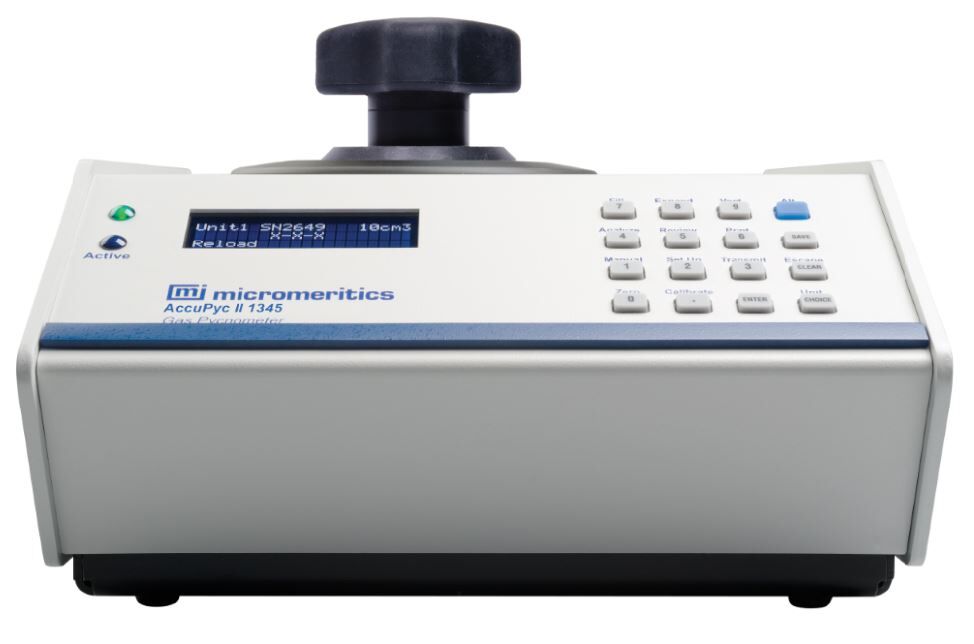
Micromeritics Accupyc II Pycnometry System
Micromeritics Accupyc II gas displacement pycnometry system is a non-destructive technique for the reliable measurement of true, absolute, skeletal, and apparent volume and density.
Find out more
Micromeritics GeoPyc Envelope Density Analyser
Micromeritics GeoPyc Envelope Density Analyser determines the volume and density of porous solid objects of irregular size and shape by using a unique displacement measurement technique.
Find out more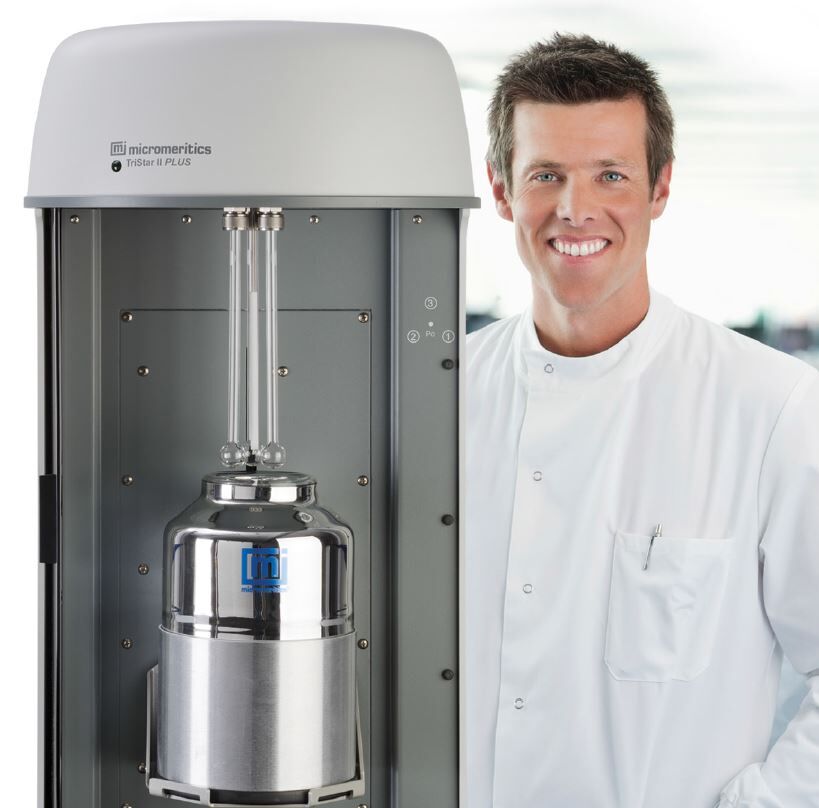
Micromeritics TriStar II Plus Surface Area Analyser
TriStar II Plus is a an automated, three-station, surface area and porosity analyser that delivers excellent repeatability and speed of analysis.
Find out moreProduct Enquiry
SPEAK TO OUR AUSTRALIAN AND NEW ZEALAND TEAM
If you would like to enquire about this product, fill out this form and one of our product specialists will contact you shortly.
If you need help in the operation or repair of an instrument then please contact the Customer Help Centre directly.
Please note, product enquiries are only applicable to Australia, New Zealand, Papua New Guinea and Fiji
Or call us instead at (02) 9541 3500